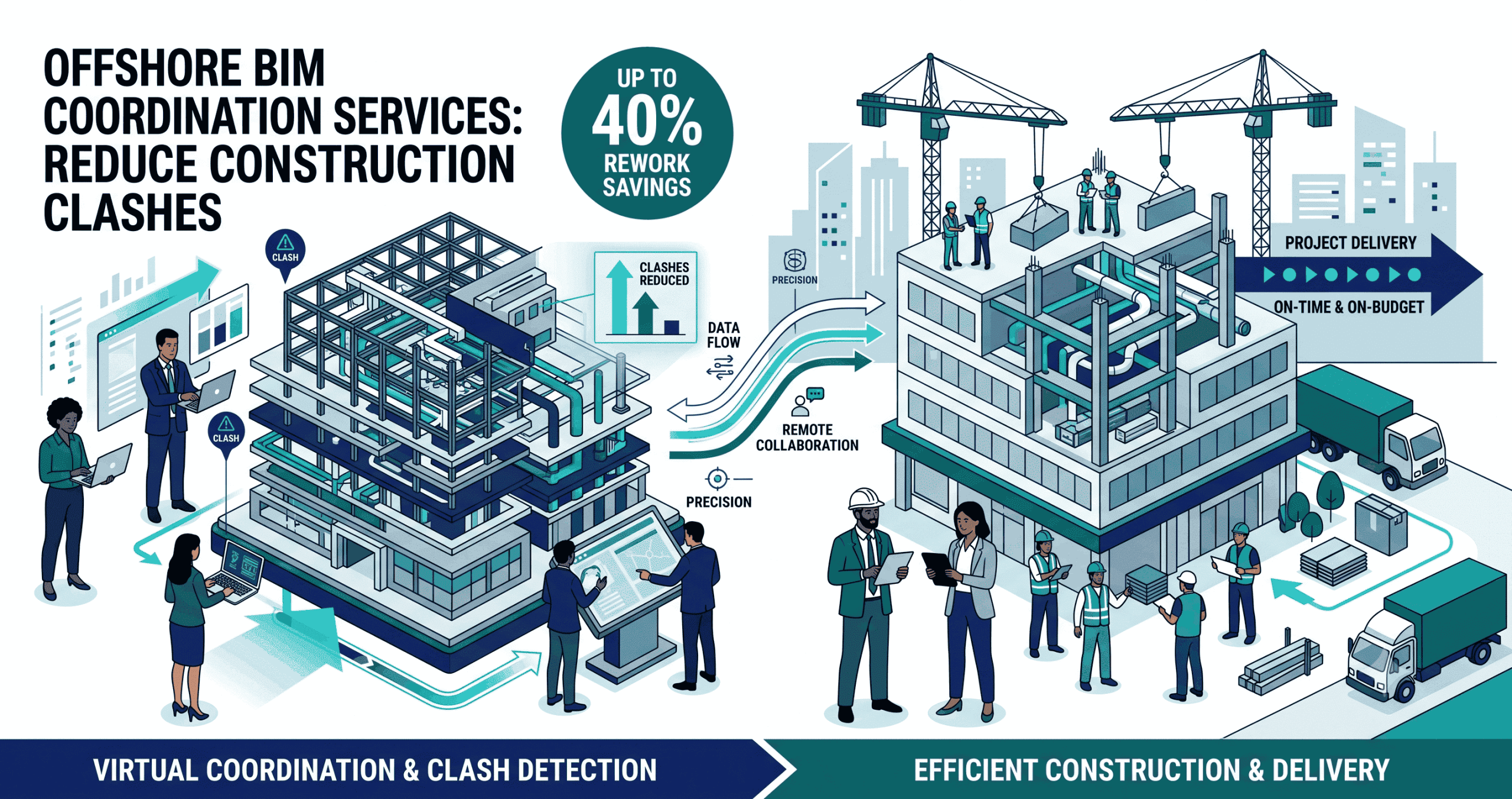
How Offshore BIM Coordination Services Reduce Rework & Construction Clashes by Up to 40%
Unplanned design clashes on a construction site are costly. When an HVAC duct intercepts a structural steel beam during installation, work pauses, field engineers scramble for an RFI solution, and the schedule slips. Field-detected clashes remain one of the primary drivers of budget overruns, material waste, and litigation across commercial and infrastructure projects.
Building Information Modeling (BIM) coordination resolves these spatial conflicts virtually long before ground is broken. However, keeping full-time, highly skilled BIM coordinators in-house can stretch overhead budgets thin. This is why leading general contractors, engineering firms, and developers leverage offshore BIM coordination services to streamline pre-construction workflows and drive down project risks.
The Real Cost of Field Clashes and Rework
In traditional construction workflows, spatial discrepancies between architectural, structural, and MEP (Mechanical, Electrical, Plumbing) disciplines are often discovered during installation.
-
Financial Impact: Resolving a clash on-site can cost up to 10 times more than fixing it during the digital design phase.
-
Schedule Slippage: Waiting on site RFIs (Requests for Information) and change order approvals leads to idle trade labor and domino-effect delays across subcontractors.
-
Material Wastage: On-site modifications mean re-ordering custom ductwork, piping, or structural elements, directly lowering profit margins.
Implementing virtual design and construction (VDC) workflows moves conflict resolution upstream into a digital environment where changes cost time—not thousands of dollars in wasted materials.
Key Benefits of Offshore BIM Coordination
Outsourcing BIM coordination to dedicated specialist teams provides the technical bandwidth needed to execute deep clash detection without burdening local staff.
1. Multi-Disciplinary Navisworks & Revit Integration
Offshore BIM specialists aggregate models from architects, structural engineers, and MEP contractors into a single federated 3D model using tools like Autodesk Navisworks and Revit. They systematically execute automated clash detection tests, distinguishing between hard clashes (e.g., plumbing pipes running through structural columns) and clearance clashes (e.g., insufficient maintenance space around high-voltage equipment).
2. Up to 40% Reduction in On-Site Rework
By identifying and resolving thousands of minor and major spatial conflicts during pre-construction, offshore VDC teams ensure that construction documentation (LOD 350 to LOD 400) reflects a fully constructible reality. This proactive clash resolution cuts field rework by up to 40%, keeping projects on schedule and within budget.
3. High-Value Resource Augmentation & Cost Efficiency
Maintaining an in-house team of senior BIM coordinators year-round incurs high fixed payroll costs, software licensing overheads, and training expenses. Partnering with an established global BIM partner offers scalable production capacity on demand—allowing firms to expand production during peak design phases and scale down during slower periods.
4. Continuous Workflow Acceleration (The “Follow-the-Sun” Model)
With offshore teams working across complementary time zones (such as US-to-India schedules), onshore design teams can upload updated design files at the close of their business day. The offshore team performs collision detection, updates Revit models, and prepares structured clash reports overnight—ensuring coordinated files are ready for review the next morning.
Step-by-Step Offshore BIM Coordination Workflow
-
Model Ingestion & Verification: The offshore team receives 3D BIM models from all trade contractors and verifies them against project standards (BEP – BIM Execution Plan).
-
Federated Model Creation: Individual disciplinary models are combined into a master federated file using Navisworks.
-
Clash Detection Run: Automated clash rules filter out false positives (e.g., embedded items) and highlight critical structural and MEP conflicts.
-
Issue Tracking & Reporting: Clashes are logged into BIM Track or Navisworks HTML/PDF reports with exact coordinates, snapshot views, and recommended resolution paths.
-
Virtual Coordination Meetings: The offshore coordinator hosts or supports regular VDC coordination meetings with trade contractors to resolve conflicts.
-
Model Updates & Sign-Off: Revisions are applied directly to the BIM model to generate accurate, constructible shop drawings (LOD 350/400).
Maximize Profitability with Dedicated VDC Partners
Proactive BIM coordination converts potential field crises into routine, digital adjustments. By combining advanced Navisworks automation with flexible global delivery teams, AEC firms can safeguard margins, speed up delivery schedules, and deliver defect-free constructible models.
Ready to optimize your pre-construction workflow? Contact AEC Digital Solutions today to discuss scaling your BIM coordination capacity.